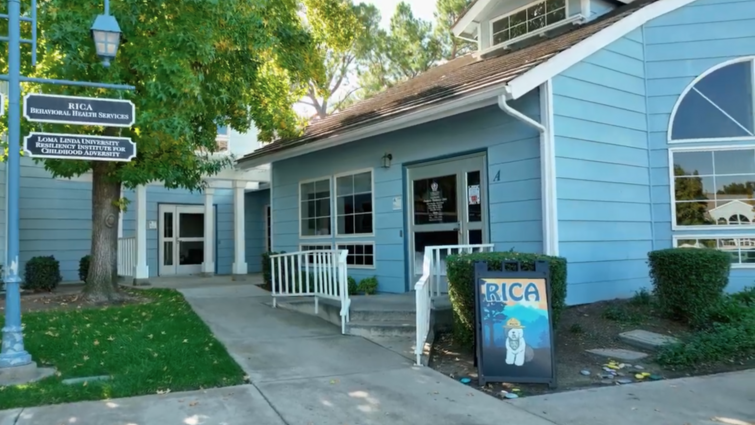
The young woman, who asked to remain anonymous for safety reasons, walked through the doors of Loma Linda University Children’s Resiliency Institute for Childhood Adversity (RICA) clinic last winter barely recognizable.
She was thin, experiencing homelessness, and exhausted in a way that went beyond lack of sleep. She had been living on the streets and in strangers’ homes, struggling with addiction and survival. Still, she knew exactly where to go.
“I came back because they were the only people I knew who would help me,” she said later.
Amy Young, MD, chief of the Division of Forensic Pediatrics at Loma Linda University Children’s Hospital and founder of RICA, remembers the moment clearly. The young woman, now in her early 20s, had once been a scholarship student in a program Young helped build. Then she disappeared for nearly three years.
“I’m very grateful that when she was at her lowest, she knew she could trust us,” said Young.
What neither of them fully realized at first was how far back their connection went.
A long memory, recovered
Years earlier, long before the program known as RICA existed, Young was the hospital’s child abuse doctor, and had examined a group of siblings after one of them was injured. Like she did with every child, she handed them a small stuffed dog, meant to offer comfort during frightening moments.
Time passed. The children entered foster care. They moved between relatives. Young lost contact.
Then, during one of their earliest conversations after the young woman’s return, she mentioned a detail she hadn’t thought about in years.
“She said, ‘I don’t remember the doctor, but she gave me a stuffed animal,’” Young recalled.
It was enough.
“That’s when I realized, I had been her doctor when she was little,” said Young.
For Young, who founded RICA, an initiative focused on providing long-term advocacy and support for vulnerable youth, the moment felt like a quiet confirmation.
“You get little nudges that tell you you’re on the right path,” she said. “That was one of them.”
The weight of being the oldest
The young woman is the oldest of five siblings. From a young age, she assumed a role that was never officially assigned: caregiver.
“I was basically their parent,” she said.
When the siblings were separated, first into foster care, later living states apart, the loss was destabilizing. Without her siblings, she lost not only her sense of family, but her sense of purpose.
The separation coincided with the young woman’s descent into substance use and homelessness. She drifted further from the person Young remembered: a high schooler who volunteered at events, cleaned up without being asked, and advocated for her siblings to be included in every opportunity she was offered.
“She was always kind,” Young said. “Always.”
A door that stayed open
When the young woman returned to RICA asking for help, there were no conditions attached.
RICA provided what Young calls “wraparound support,” which includes help getting sober, medical care, educational advocacy, housing assistance, job placement, clothing, food, laptops, transportation, and help securing identification and benefits.
The team worked with county housing navigators to secure rental assistance and found a landlord willing to rent to young adults without credit or stable income.
“They didn’t just give me a place to stay,” she said. “They fed me. They clothed me. They helped me get my life back.”
Perhaps most critically, RICA helped reunite her with her two younger siblings under one roof.
Living together again has brought moments of typical sibling chaos, jokes, but also healing.
“Sometimes they drive me crazy,” she laughed. “But I love it. I never thought I’d get this.”
She speaks with particular tenderness about the mundane. Cooking meals, sitting outside her brother’s room when he tells her to leave, trying, unsuccessfully, to read her sister a childhood book at bedtime.
“This is sibling love,” she said. “It’s messy, but it’s everything.”
Safety before hope
Young says that none of the progress would have been possible without first meeting the most basic needs.
“When kids don’t know where they’re sleeping or what they’re eating, nothing else works,” she said. “You can offer education and opportunities, but without safety and trust, it doesn’t matter.”
Trust, she said, is built slowly. “You have to show up over and over again.”
The young woman agrees. “It took time,” she said. “But eventually I leaned in.”
Today, she has been sober for five months. She has a job. She has a home. She has begun rebuilding relationships with her siblings, with her grandmother, and with herself.
“I didn’t think I was going to make it,” she said. “I really didn’t.”
What hope looks like now
“All it takes is a want,” she said. “If you really want something, really want it, you’ll find a way.”
For her, that want began with keeping her siblings safe. Now, it includes herself.
“I’m free,” she said. “Like, really free. I don’t have to worry about where I’m sleeping or who’s watching me.”
Young sees her transformation not as a miracle, but as proof of what sustained support can do.
A model that endures
RICA continues to serve youth navigating foster care, homelessness, and the transition to adulthood, many of whom return years later, just as this young woman did.
“The door doesn’t close,” Young said. “That’s the point.”
For the young woman who carried a stuffed animal through childhood and came back carrying the weight of survival, that open door made all the difference.
“I lost a lot of myself,” she said. “But I’m finding it again.”
And this time, she isn’t doing it alone.
To learn more about how the Loma Linda University Children’s Resiliency Institute for Childhood Adversity supports vulnerable youth, and how sustained, trauma-informed care can change lives long after childhood, contact RICA.
More stories about: Children’s Hospital Children's health Resiliency Institute for Childhood Adversity
Related Articles