

Instilling gratitude at a young age sets children up for long-term emotional success, per experts.
You may think thankfulness is innate. Some people are just born with a more positive, grateful spirit. The fact is, thankfulness can be developed, and when developed early, it can set your child up for long-term emotional success.
Two Loma Linda University Children’s Hospital experts have simple yet powerful ways to practice gratitude as a family.
Kiti Freier Randall, PhD, a pediatric neurodevelopmental psychologist and chief of the Division of Psychological Services for the Department of Pediatrics, and Jamie Pivonka-Jones, PHD, a pediatric neuropsychologist, discussed gratitude, its effects on a child’s development, and things parents can do to develop gratitude in their children. Here are some edited excerpts.
First, why is thanksgiving — the practice as opposed to the holiday — so important in a child’s psychological development?
Freier Randall: Thanksgiving has two elements in its name: “thanks” and “giving.” We know both are important for positive mental health, which is why we emphasize an attitude of gratitude. We also know that giving, or service learning, is a huge part of developing resiliency for young people and for all of us, really. Thanksgiving helps us build positivity and resilience.
What are some simple ways parents can practice gratitude with their children?
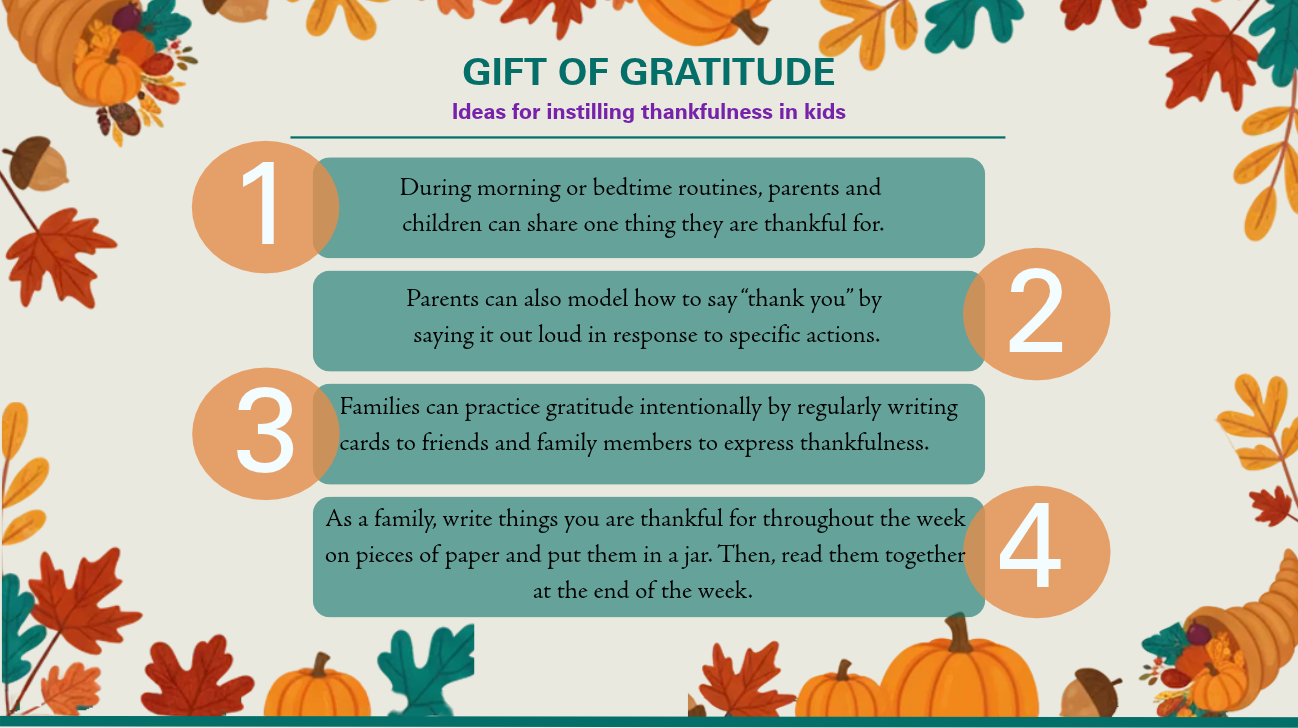
Freier Randall: During morning or bedtime routines, parents and children can share one thing they are thankful for. Parents can also model how to say “thank you” by saying it out loud in response to specific actions, like “Thank you for helping me clean up” or “Thank you for helping me find my toy.” Families can also practice gratitude intentionally by regularly writing cards to friends and family members to express thankfulness. The most important thing is that parents and caregivers model gratitude and talk about it out loud.
From a brain-development perspective, why are repeated family gratitude activities so beneficial for a child’s own mental health?
Freier Randall: Repeated activities create or form templates or habitual ways of responding and interacting. These templates are called “procedural memory,” and they become automatic. Think about tying your shoes: you know how to do it, but you may find it difficult to explain each step because the process has become automatic. In much the same way, our early experiences help establish deeply rooted patterns. The first three to five years of life are a particularly important period as repeated experiences begin to shape the foundations of our emotional responses, expectations, and ways of interacting with the world.
How much does practicing gratitude in early childhood matter?
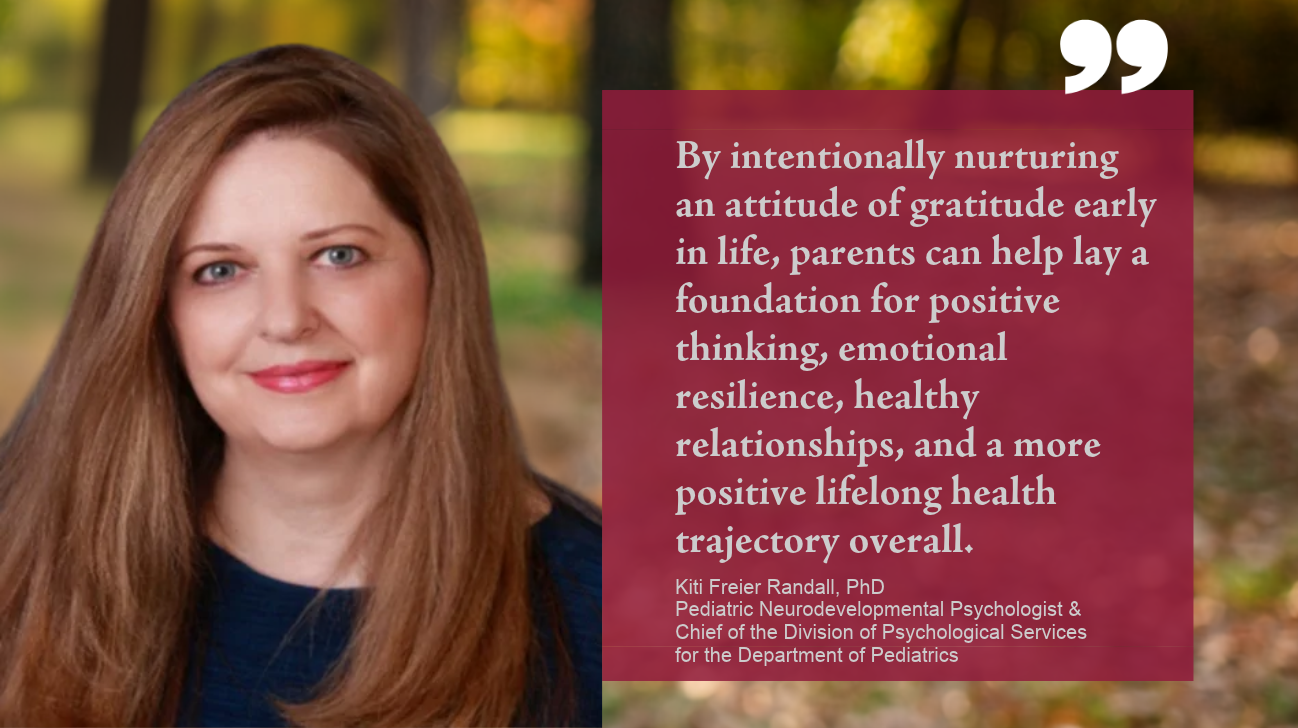
Freier Randall: It's significant. When children are regularly exposed to positive experiences of appreciation and gratitude, they have opportunities to develop these ways of thinking and responding as habitual patterns. Research increasingly recognizes the important relationship between gratitude and both mental and physical health. By intentionally nurturing an attitude of gratitude early in life, parents can help lay a foundation for positive thinking, emotional resilience, healthy relationships, and a more positive lifelong health trajectory overall.
Does gratitude make a child happier?
Pivonka-Jones: Many young children experience gratitude as the feeling you get when you do something nice for others. It’s very closely aligned with empathy. As children grow and understand more complex components of gratitude and empathy, they can engage in prosocial behavior with a deeper understanding of the benefits for themselves and others. Children who report this deeper understanding at ages nine and up generally report higher scores on measures of optimism. They also tend to be liked more by same-aged peers.
On a similar note, can practicing gratitude help children cope with more difficult emotions?
Pivonka-Jones: Absolutely. As I just mentioned, practicing gratitude and finding the good things in all experiences, including those that bring up uncomfortable negative emotions, are incredibly important for supporting coping and resilience. I often teach parents to make statements like, "Aren't we so lucky to live a life where we can feel all our feelings and use words to describe our experiences and learn from them?” This allows their child space to share their feelings.
As adults, we can provide positive reframes when the timing is right and in a developmentally appropriate way. We want to make sure children feel safe sharing all their feelings without stigma, and gratitude, if practiced regularly, will become a natural part of the coping process. It’s important not to use gratitude to shut down negative emotions, but to include it in a discussion as an additional experience.
What about the “giving” part of Thanksgiving? What lasting mental health benefits can children gain from helping others?
Freier Randall: Research on resilience and well-being consistently emphasizes the value of helping others and participating in community service. When children engage in acts of service, they learn to look beyond their own needs and recognize that they can make a meaningful difference in others' lives.
Helping others benefits both the giver and the receiver. Strong social connections and a sense of belonging contribute to both psychological and physical well-being, including healthy immune function. Acts of kindness and service can strengthen these connections, foster positive relationships, and contribute to our own emotional well-being.
Service to others also provides children with something especially important for healthy development: a sense of purpose. When children recognize that their actions can positively affect someone else, they begin to see themselves as capable, valuable, and connected members of their family and community. A sense of purpose also contributes to resiliency.
The holidays can be busy and exciting. How can families balance that excitement with gratitude during the holiday season?
Freier Randall: One of the best ways to balance excitement and gratitude is to include children in preparing and planning Thanksgiving and other family gatherings. Rather than simply waiting in uncertainty or expectation for the celebration, give them meaningful ways to participate. They can help prepare food, set the table, make place cards, and decorate. The goal isn't to take away the excitement of Thanksgiving. Including children in creating the celebration and modeling gratitude along the way gives that excitement greater meaning.
Pivonka-Jones: Exactly. I'd add that the holidays are a great opportunity for children to practice emotional reframes amidst any added stress. It’s not about decorating the perfect cookie; it’s about being grateful to spend time baking with a loved one they haven't seen in a while, for example. Gratitude can help keep the focus on what is truly important over the holidays.
Concerned about your child’s mental health? Click here or call 909-558-9113 for more information about youth behavioral health programs offered by Loma Linda University Health.
More stories about: Children's health Children’s Hospital General Pediatrics Behavioral Health
Related Articles