
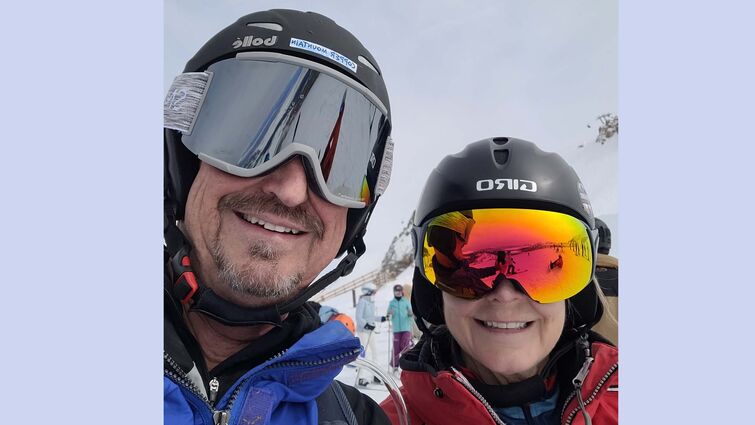
John Lorenz and his wife Melva are avid skiers. He recently underwent a procedure to release a trigger finger, which had affected his ability to release his grip on a ski pole.
John Lorenz can use his left hand with normal function again after undergoing a minimally invasive procedure to eliminate a trigger finger complication that had restrained the use of his middle finger, often requiring him to use his other hand to straighten his finger.
Instead of the traditional open surgery that would have required an operating room or ambulatory surgical center, possible anesthesia, and a larger incision on his hand requiring sutures, a Loma Linda University Health physician performed the procedure in an outpatient office using a local numbing agent, a tiny incision, and real-time ultrasound guidance — all for a procedure that took no more than 20 minutes from start to finish.
Lorenz said the relief was immediate. “My finger is doing well,” he said a few days after the procedure. “It has healed nicely. I don’t have any tension in the tendon.”
The procedure was the first of its kind performed at Loma Linda University Health. The milestone highlights how more procedures are trending toward the minimally invasive approach, whether cardiac issues or orthopaedic knee or hand issues.
For Lorenz, a 66-year-old administrator in LLUH’s Department of Medicine, use of his left hand had been hindered for more than a year. Gripping sacks of horse feed on his ranch or a ski pole on slopes in the winter sometimes required him to use two hands to release his curved finger. Some mornings he would have to use his other hand to open his finger upon waking up.
A steroid injection relieved trigger finger symptoms, but only for a few months. When Lorenz went to his doctor to receive another injection, he learned about a new procedure that would remove the problem permanently.
Michael Villasin, MD, MPH, who performed the procedure, had conducted more than 6,000 ultrasound-guided procedures over the past three years before recently coming to work at LLUH. His experience as a family medicine physician specializing in sports medicine gave him an opportunity to show Lorenz an emerging option for trigger finger release.
Villasin told Lorenz that he could place an ultrasound probe on Lorenz’s open palm and knuckles to guide his needle and hook knife to release the trigger finger. The incision would be less than half an inch and would be in a crease of his palm, hiding any scarring that may occur.
Lorenz agreed, eager to get relief.
Villasin and his team prepared Lorenz for the procedure by sterilizing the area on his hand, injecting a numbing agent, and then creating a small incision. Villasin used ultrasound to visually monitor the area as he guided a device in the finger tendon sheath. He used a tiny blade to cut through the first annular pulley ligament, which released the trigger finger. The pulley is natural anatomy, but inflammation within the tendon sheath can cause the tendon to catch on the pulley. Villasin said the finger can work well even when that particular ligament has been cut.
Villasin recalled that Lorenz felt immediate relief. “Immediately after we were done, even before we applied small, adhesive bandages to the area, he was opening and closing his hand without any issues of it locking or catching,” Villasin said.
Some 300,000 trigger finger release surgeries are performed in the United States annually, most of which use a traditional open procedure and require a two-week recovery period. But this minimally invasive approach opens the door for people who can’t take time off work, have to take care of a loved one, or have other reasons they can’t go into the operating room, Villasin said.
“Patients are usually quite happy to learn that they have more options than the traditional surgery that leaves them unable to use their hand for two weeks,” he said.
At LLUH, Villasin is also treating carpal tunnel syndrome with newly available minimally invasive approaches.
“If patients are experiencing these type of symptoms in their hands, it doesn’t mean they need to immediately have the procedure, but it can be good for them to see what the options are,” Dr. Villasin said. “We can walk them through the options, from everything from doing nothing to all the way to doing this type of advanced procedure.”
For more information, call 909-558-6560. You can also learn more by exploring sports medicine and related orthopaedic services.
More stories about: Orthopaedics
Related Articles