
Many people underestimate how much cumulative sun exposure they receive during normal daily life.
As summer approaches and more people spend time outdoors, skin experts at Loma Linda University Health say many common misconceptions about sunscreen and sun protection may be putting people at greater risk for skin cancer.
During Skin Cancer Awareness Month, providers are encouraging the public to think beyond beach days and recognize that harmful ultraviolet (UV) exposure often happens during everyday activities.
“Skin cancer is one of the most common and one of the most preventable cancers,” says Kristin Smith, a dermatology physician assistant-certified at Loma Linda University Health. “Heading into summer, people naturally spend more time outdoors, increasing exposure to ultraviolet radiation from the sun, which is the leading risk factor for most skin cancers.”
Myth 1: Only sunny days matter
One of the biggest myths Smith hears is that sunscreen is only necessary during prolonged outdoor activities.
“UV exposure happens during everyday activities like driving, walking, gardening, or sitting near windows,” Smith says. “Damage builds up over time, even with short periods outdoors.”
Myth 2: Clouds block UV Rays
Many people also mistakenly believe cloudy weather offers protection from the sun.
“Up to 80% of UV rays can penetrate clouds, so skin damage can still occur even when it doesn’t feel sunny,” Smith says.
Myth 3: Darker skin is safe
Another misconception is that only people with fair skin are at risk for skin cancer.
“While darker skin has more natural protection against UV damage, skin cancer can still occur and is often diagnosed later in these populations,” Smith says.
Myth 4: Higher SPF lasts all day
Smith adds that higher SPF numbers do not eliminate the need to reapply sunscreen throughout the day.
“SPF 30 blocks about 97% of UVB rays, while SPF 50 blocks about 98%,” she says. “Reapplication every two hours and after swimming or sweating is still essential.”
Myth 5: Makeup SPF is enough
She also cautions against relying only on makeup or moisturizers that contain SPF.
“These products can help, but most people don’t apply them thickly enough to achieve the labeled SPF protection,” Smith says.
How to protect yourself
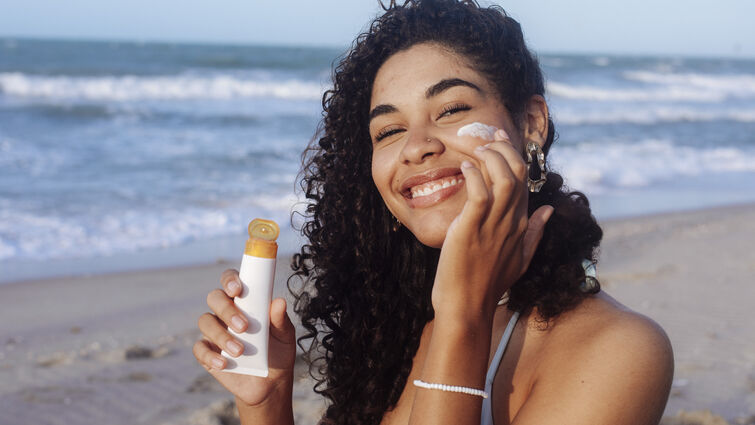
Proper sunscreen use starts with choosing a broad-spectrum sunscreen with at least SPF 30 and applying it 15 to 30 minutes before sun exposure. Most adults need about one ounce to cover the body and a nickel-sized amount for the face alone. Commonly missed areas include the ears, neck, scalp, hands, tops of the feet, and lips.
Beyond sunscreen, Smith encourages people to incorporate other forms of sun protection into their daily routine, including wide-brim hats, sunglasses with UV protection, UPF-rated clothing, and seeking shade during peak sun hours between 10 a.m. and 4 p.m.
Experts also encourage people to regularly check their skin for unusual or changing spots. Warning signs can include a mole that changes in size, shape, or color, a sore that does not heal, or a spot that looks noticeably different from others.
“We often summarize warning signs using the ‘ABCDEs’ of melanoma,” Smith says, referring to asymmetry, irregular borders, uneven color, diameter, and evolving changes in a mole or lesion.
The biggest takeaway
Smith says many people underestimate how much cumulative sun exposure they receive during normal daily life.
“A few minutes here and there every day can add up to hours of exposure each week over a lifetime,” she says.
To learn more about skin cancer prevention or schedule a skin evaluation, visit the Loma Linda University Cancer Center.
More stories about: Cancer Center Health Tips Healthcare
Related Articles