
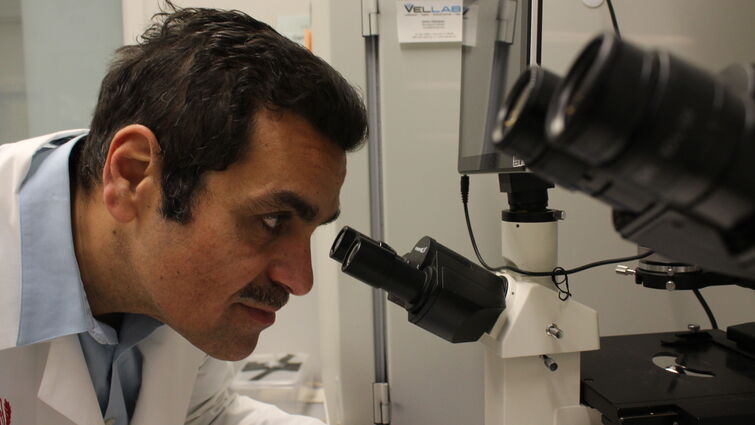
Dr. Abdel-Azim says one of the most promising advances in the treatment of multiple myeloma is chimeric antigen receptor T-cell therapy, or CAR T.
Multiple myeloma, a type of blood cancer that affects plasma cells, has long been considered a difficult disease to treat. Today, new therapies are reshaping what that diagnosis means for patients.
According to the American Cancer Society, more than 36,000 people in the United States are expected to be diagnosed with multiple myeloma this year. While the disease has traditionally been considered incurable, advances in treatment are helping patients live longer, and in some cases, even reach long term remission.
“At one point, multiple myeloma was a disease that would almost always return after treatment,” says Hisham Abdel-Azim, MD, division chief of hematologic malignancies and transplant/cellular therapy at Loma Linda University Health. “Now, with the therapies we have available, we are able to significantly modify the disease course, extend survival and, in some cases, transform this into more of a chronic condition.”
Understanding multiple myeloma
Multiple myeloma develops in plasma cells, a type of white blood cell found in the bone marrow. The disease can affect multiple systems in the body, often causing bone pain, anemia, kidney damage, and an increased risk of infection.
Symptoms vary widely. Some patients experience persistent back or rib pain, fatigue, or frequent infections, while others may initially have only abnormal lab results.
Diagnosis typically begins with blood tests that detect abnormal proteins produced by myeloma cells, followed by additional testing such as bone marrow biopsy and imaging to confirm the disease.
How treatment has evolved
For years, chemotherapy has been a cornerstone of myeloma treatment. While it still plays a role today, newer therapies are rapidly changing the treatment landscape and improving outcomes.
“Chemotherapy has traditionally been a standard part of treatment, especially early on or in relapsed disease,” says Abdel-Azim. “But its role has been gradually decreasing as we’ve developed more effective targeted therapies with fewer side effects.”
Today, treatment often includes a combination of targeted therapies, immunotherapies, and, in some cases, stem cell transplant. These approaches are tailored to each patient based on the stage of disease and overall health.
CAR T therapy: A new frontier
One of the most promising advances in the treatment of multiple myeloma is chimeric antigen receptor T-cell therapy, or CAR T.
This approach uses a patient’s own immune cells, which are modified in a lab to recognize and attack cancer cells. In multiple myeloma, CAR T therapies often target a protein called B-cell maturation antigen (BCMA) found on malignant plasma cells.
Clinical trials have shown strong results, particularly for patients whose disease has returned or not responded to initial treatments.
“These therapies have demonstrated very high response and remission rates, even in patients who had very limited options before,” Abdel-Azim says.
CAR T therapy is typically given as a one-time infusion, offering a different experience compared to ongoing treatments.
Expanding options for patients
In addition to CAR T, newer immunotherapies such as bispecific antibodies are expanding treatment options by helping the immune system better recognize and destroy cancer cells.
“The important thing is that we now have a growing number of effective therapies,” Abdel-Azim says. “If a patient relapses after one treatment, we often have other options that can still be very effective.”
CAR T therapy has shown response rates of more than 80%, with over half of patients achieving complete remission, and has been associated with improved survival outcomes. Still, no single approach works for everyone.
A comprehensive approach close to home
At Loma Linda University Cancer Center, patients have access to advanced therapies including CAR T and bispecific antibodies, as well as clinical trials and specialized care.
“We treat the patient as a whole, not just the disease,” Abdel-Azim says. “That includes medical treatment, but also psychosocial support and nutritional care to help patients through their journey.”
As the only Foundation for the Accreditation of Cellular Therapy (FACT)-accredited center in the Inland Empire, Loma Linda provides access to these advanced treatments locally, something not widely available in the surrounding region.
Looking ahead
With continued advances in treatment, the outlook for patients with multiple myeloma continues to improve.
“We’ve seen tremendous progress,” Abdel-Azim says. “Many patients are living longer and can return to their normal activities. In some cases, we are even seeing long-term remission.”
As research continues, that progress is expected to grow, offering renewed hope to patients and families facing a multiple myeloma diagnosis.
To learn more about multiple myeloma treatment options or to schedule a consultation, visit the Loma Linda University Cancer Center or speak with your physician about a referral.
More stories about: Cancer Center Cancer patients