
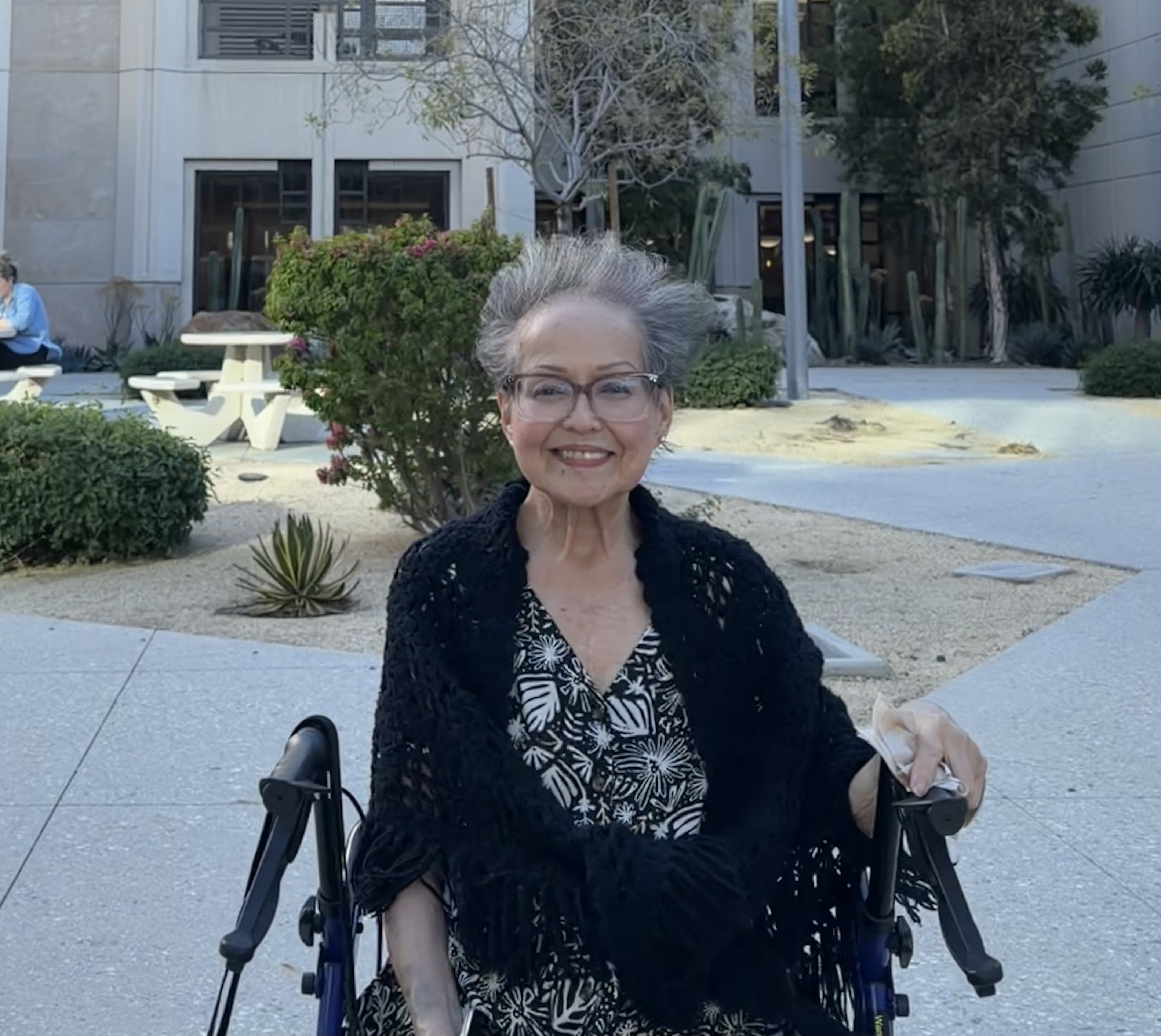
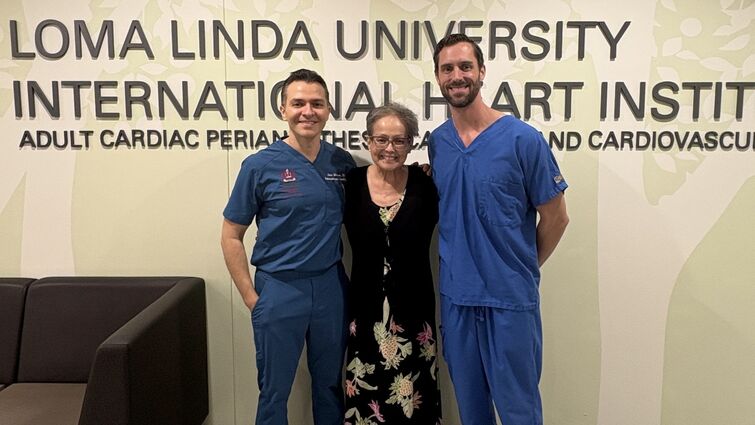
Joy Campbell (center) became the first patient on the West Coast to receive the new minimally invasive mitral valve replacement at LLUH in a non-clinical trial site by structural interventional cardiologists Dr. Amr Mohsen (left) and Dr. Jason Hoff (right).
Loma Linda University Health (LLUH) has achieved a major milestone in advanced heart care, becoming the first non-trial hospital on the West Coast to perform a minimally invasive mitral valve replacement on February 24, using the newly FDA-approved transcatheter mitral valve system by Edwards Lifesciences.
For decades, patients who needed a mitral valve replacement had only one option: open-heart surgery. For many older or medically fragile patients, that surgery carried too much risk. If they were not strong enough to withstand it, there were no other alternatives, and their condition often continued to worsen.
Now, there is another path.
Until late 2025, replacing the mitral valve required opening the chest, stopping the heart, and placing the patient on a heart-lung machine. While lifesaving for many, it involves significant recovery time and physical stress.
“Patients who were not surgical candidates essentially had no solution,” says Amr Mohsen, MD, a structural interventional cardiologist at LLUH. “They would come into the hospital repeatedly with heart failure symptoms. We could manage them temporarily with medications, but the underlying valve problem remained.”
The mitral valve regulates blood flow between the heart’s left chambers. When it fails, either by leaking severely or no longer functioning properly, patients can experience extreme fatigue, shortness of breath, fluid buildup, and frequent hospitalizations.
With the new device, physicians can replace the mitral valve through a vein in the leg, avoiding open-heart surgery entirely. The procedure typically takes about 90 minutes or less. Patients are awake shortly afterward, walking the same day, and often go home within 24 to 48 hours.
“It’s night and day compared to surgery,” says Mohsen. “There is minimal recovery time. We tell patients, ‘go home and go back to your life.’”
A new lease on life
Joy Campbell, 76, knows firsthand what it feels like to run out of options. Over the past several months, she was hospitalized multiple times with worsening heart failure caused by her failing mitral valve. She became so weak that she could barely climb the stairs.
“I couldn’t even walk,” Campbell says. “I love being outside, tending to my plants. I didn’t have the energy. I felt older than 76.”
Due to her overall health and frailty, open-heart surgery was not considered safe. Before this technology became available, she would have continued cycling in and out of the hospital.
Instead, she became the first patient on the West Coast to receive the new minimally invasive mitral valve replacement at LLUH in a non-clinical trial site after recent FDA approval.
The morning after her procedure, she was walking, eating dinner, and preparing to go home. “It’s my new lease on life,” says Campbell. “If my journey can help someone else, I’m ready. I’m so grateful.”
The complexity of this procedure
Unlike the other heart valves, the mitral valve isn’t perfectly round — it has a more complex shape. That makes it much harder to replace without opening the chest.
The new device solves that problem by using a two-part design: a docking component that stabilizes the valve structure, followed by deployment of a replacement valve inside it.
The entire procedure is performed using advanced imaging guidance.
“I don’t directly see the patient’s native valve physically in front of me as a surgeon would,” Mohsen explains. “I’m working through a vein in the leg, watching detailed heart imaging on a screen. It requires meticulous planning and an experienced imaging team.”
At LLUH, the procedure is supported by a multidisciplinary team that includes structural interventional cardiologists, cardiac surgeons, advanced imaging specialists, and heart failure experts. Patients are closely monitored after the procedure and receive coordinated follow-up care.
“This is not something that can be done at every center,” Mohsen says. “It requires experience, preparation, and a strong team.”
The biggest challenge now is awareness.
“Many physicians and patients don’t yet realize this option exists,” says Mohsen. “That’s why sharing these stories matters. Patients who were previously told there was nothing more that could be done should know there may be a solution.”
He emphasizes that patients who have been turned down for surgery elsewhere or who continue to struggle with worsening heart failure should not assume they are out of options.
For Campbell, the breakthrough means returning to the life she thought she was losing. “I’m ready to start walking again,” she says. “I’m ready to get back to my plants.”
What patients should know
Minimally invasive mitral valve replacement is for those with severe disease who are not candidates for open-heart surgery due to age, frailty, or other medical conditions.
If you or a loved one is at high risk for open-heart surgery or has worsening mitral valve symptoms, consult your cardiologist about seeing a structural heart specialist.
For more information or to request an evaluation, call 1-800-INTL-HEART (468-5432) or visit the Structural & Valvular Heart Disease Care website.
More stories about: Heart & Vascular Heart patients
Related Articles