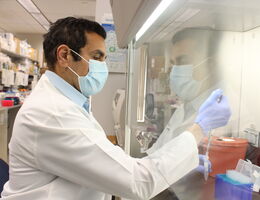


Loma Linda University Cancer Center director explains how daraxonrasib works, who qualifies, and what it could mean for patients.
Pancreatic cancer is one of the deadliest and most aggressive cancers. The American Cancer Society estimates that nearly 53,000 Americans will die from the disease in 2026.
However, as Mark Reeves, MD, PhD, director of Loma Linda University Cancer Center, explains, a diagnosis that might once have been a death sentence may not be anymore, thanks to daraxonrasib, a treatment approved by the FDA a little over 2 months ago.
Why is pancreatic cancer so hard to treat?
Pancreatic cancer is commonly diagnosed in its later stages because it causes little to no symptoms early on, and by the time it is found, it has often spread to other parts of the body. The five-year relative survival rate for all stages is about 13%, according to the American Cancer Society, largely because of how late the disease is often diagnosed.
Treatment has also been difficult because RAS, a key molecule driving pancreatic cancer, has long been considered “undruggable,” as Reeves describes.
“RAS mutates quite frequently, and the biggest problem with treating pancreatic cancer in the past was that the drugs weren’t able to impact RAS mutants,” he explains.
What is daraxonrasib?
Daraxonrasib works by binding to the active form of RAS and blocking the signals that drive tumor growth.
In a phase 3 clinical trial of 500 patients with previously treated metastatic pancreatic cancer, those who took daraxonrasib lived a median of 13.2 months, compared with 6.7 months for those who received chemotherapy.
“This is a significant increase in outcome that could change not only how long pancreatic patients are living, but their quality of life,” Reeves says.
Who qualifies for this new treatment?
Daraxonrasib is approved for adults with metastatic pancreatic cancer who have already received at least one other systemic treatment or who are not candidates for combination drug therapy.
Unlike chemotherapy, which is given through an IV, daraxonrasib is a daily pill. In the trial, patients taking it also had fewer severe side effects than those receiving chemotherapy.
November is Pancreatic Cancer Awareness Month, and Loma Linda University Health is committed to raising awareness and supporting patients and families affected by pancreatic cancer. To learn more about daraxonrasib and the resources available to patients at the Cancer Center, visit lluh.org/cancer-center or call 1-800-782-2623 to make an appointment.
More stories about: Cancer Center