Teen shares story of perseverance amid harrowing diagnosis.
Alexander “Alex” Taylor was just 15 years old when what he thought was just a bad cough turned out to be a frightening diagnosis.
“I'm like, this is not a normal cough,” Alex said. “I told my parents about it, and they took me to urgent care where they gave me some antibiotics. I tried those, and those didn't work.”
Alex’s cough turned out to be an aggressive cancer that had already spread to his lungs, abdomen, and lymph nodes.
For Alex, the idea that he might have cancer did not even cross his mind.
His mom, Julie Taylor, had a different experience, a feeling that could be called a mother’s intuition.
“They didn't confirm it, but I knew,” Julie said. “We came to the Emergency Department at Loma Linda and they did their tests. At the end of the night, they finally told us the whole diagnosis.”
Julie called that day the “worst day” of her life.
A treatment journey begins
For Alex, it was the beginning of a treatment journey that would keep him from activities he enjoyed, like running track and going to theme parks. He even missed going to school.
“I missed my friends. And I missed school," Alex said. “That's something that's super weird to hear coming from a 16-year-old teenager, that I want to go to school.”
But instead of going to school, Alex spent the next year undergoing several rounds of chemotherapy, several surgeries, and two autologous stem cell transplants for cancer that spread to his brain.
According to Alex, it felt like every time they got rid of cancer in one place in his body, it popped up in another.
“The reality is you really don't know what's coming,” said Alex. “That's why this disease sucks so much. It just does whatever it wants.”
Julie echoed that sentiment.
“Every day, we're nervous, thinking 'What's going to happen tomorrow? What is this lab going to say?’ That's kind of a hard way to live,” said Julie.
Cancer impacts the whole family
The journey has been tough for the rest of Alex’s family, as well, including his two siblings: a 19-year-old and 10-year-old brothers.
Alex said he thinks cancer’s impact on families is not talked about enough.
"It affects more than just the patient, themself,” said Alex.
While family members take turns spending time with Alex when he is in the hospital, Julie admits, at times, their shifting schedules can feel chaotic.
Julie said they are lucky to have an amazing support system during those busier times.
“Not just our family, but like friends. Everybody has stepped up to help,” said Julie. “And my husband's amazing. He holds the fort down at home.”
A way to cope
Alex has found several ways to feel grounded during periods of uncertainty.
He writes in his journal and spreads awareness of pediatric cancer on social media, frequently posting on social media.
In one video, Alex talks about his specific diagnosis in an attempt to help other teenage boys feel less uncomfortable about sharing any symptoms they may be experiencing.
“My specific diagnosis was a germ cell tumor that was located in my testicle, and nobody wants to talk about that,” said Alex on TikTok. “I mean, I feel awkward talking about it.”
“But it’s so, so, so important for people to know the symptoms and be aware.”
Room for improvement
Alex’s form of cancer is uncommon.
According to the American Academy of Pediatrics, testicular cancer makes up approximately 4% of all cancers in children and teenagers and is more likely to occur following puberty.
The good news is that testicular cancer is highly treatable, and treatment of pediatric cancer has improved greatly over the past half century. The five-year survival rate among adolescents between the ages of 15 and 19 is now 87.3%, according to the National Cancer Institute, compared to just 68% in the mid-1970s.
Albert Kheradpour, MD, chief of pediatric hematology/oncology at Loma Linda University Children’s Hospital, said he has seen so much improvement in the past few decades.
“The equipment we have access to makes diagnosis much easier,” said Kheradpour. “With new drugs, we get less toxicity, so the patient does not suffer as much during treatment.”
Bright spots in the battle against cancer
Alex is still battling cancer.
Julie said she thinks he is feeling the best and looking the best he has in a long time, attributing that to the staff at Loma Linda.
“Alex is literally in their hands, and I've trusted them every step of the way,” said Julie, “The way they care for him. It's like their own kid.”
Alex certainly would not like to spend so much time in the hospital, but he too has found an unexpected upshot through the kindness of the nurses.
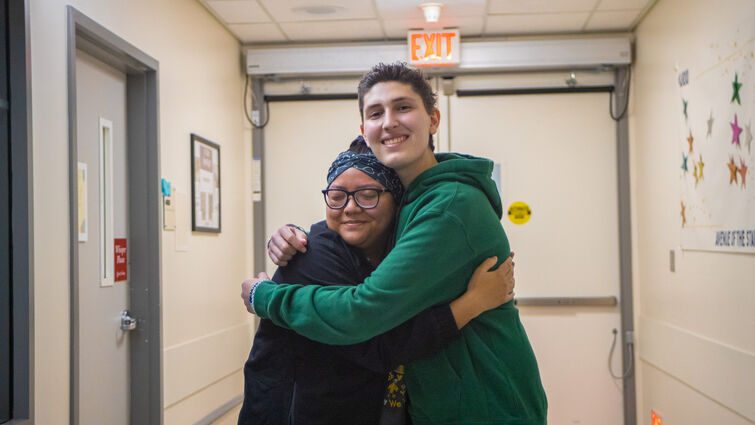
On a recent visit to the hospital, Alex was greeted by one of the nurses, who called him “bestie,” with a huge hug. Another nurse makes him specialty mocktails, including his favorite, which they call, “the sunrise surprise.”
“The nurses, the staff here are all so amazing and wonderful,” said Alex. “Cancer is the worst way to meet some of the best people.”
For more information about pediatric cancer care at LLUCH, click here.
More stories about: Pediatric Cancer Cancer patients Children’s Hospital Children's health
Related Articles