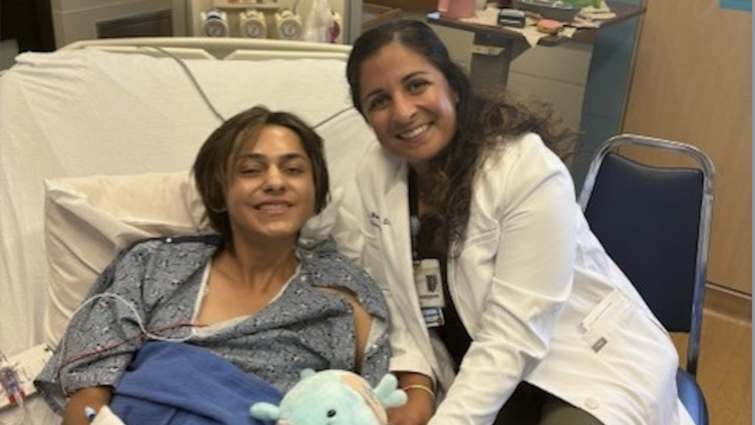
LLUCH patient Jesse Campos, left, with his neurosurgeon, Dr. Tanya Minasian
When Jesse Campos was a freshman in high school, a faint twitch appeared in his eye. At first, it was easy to dismiss. But over time, the twitch spread to his nose, then his mouth, then his throat, and eventually his hand.
“It stressed me out,” Campos said. “Sometimes I’d be mid-conversation or mid-presentation at school, and it would just start twitching.”
When the twitching reached his throat, he said, “I stopped breathing. It cut off my airway.” When it reached his mouth, he couldn’t speak.
Campos, now 18, lives in Calexico, a small city in California’s Imperial Valley. With limited access to specialized care, he was referred to doctors in San Diego after the seizures began, about six months before his diagnosis. Imaging revealed the cause: a cavernoma, a rare cluster of abnormally formed blood vessels, located on the right side of his brain in an area responsible for movement.
Some physicians recommended immediate surgery. But Campos and his family hesitated.
They found Tanya Minasian, DO, a pediatric neurosurgeon at Loma Linda University Children’s Hospital, more than three hours from home.
Campos’s cavernoma, Minasian says, was especially complex. “Campos had a large cavernoma which was located in the motor area of his brain,” Minasian said. “Given the eloquent location of the lesion, performing surgery while he was awake would allow us to remove the cavernoma as safely as possible. Awake craniotomy helps to preserve critical brain function- in this case, motor function.”
The primary concern was paralysis. “Weakness to the left side of his body, including his face,” Minasian said.
While under Minasian’s care, Campos underwent MRIs and specialized testing to track the cavernoma’s growth and potential bleeding.
Campos felt his seizures worsen. “They kept moving down,” Campos said. “First, my eye. Then my nose. Then my mouth. Then my hand.”
By his junior year, the seizures were affecting half of his hand and interfering with daily life.
When Campos was ready to proceed with surgery, Minasian discussed the option of an awake craniotomy, a procedure that allows surgeons to remove brain lesions while the patient is awake and responsive.
“Awake craniotomies are not for every patient or every pathology,” she said. “But is a very good option for certain brain lesions that are in important and critical structures of the brain.”
She explained that “the brain itself does not have pain fibers. So, the patient can be awake during the removal of the actual brain lesion. Patients are asleep for the painful portions of the surgery, including the incision, bone removal, and closure. It’s referred to as an asleep-awake-asleep technique.”
The benefit of keeping the patient awake is the immediate feedback it provides. “The surgeon is provided immediate feedback on the patient’s neurologic status,” Minasian said. “We want to remove as much of the brain abnormality as possible, while maintaining normal neurologic function.”
That feedback can prevent permanent damage. “It helps a great deal,” she said. “With this immediate feedback, the surgeon can safely continue working if the patient is doing well. And similarly, if a maneuver during the resection yields a neurologic issue for the patient, we would stop or modify our approach.”
Campos chose the awake surgery.
“I trusted Dr. Minasian,” he said. “And I felt like this was better because during the surgery, I’d be moving. I’d know I wasn’t getting paralysis.”
In August 2025, Campos underwent surgery, supported by a multidisciplinary team led by pediatric neurosurgeon Minasian and including vascular neurosurgeon Promod Pillai, MBBS, pediatric anesthesiologist Patrick Leiter, MD, Child Life Specialist Kim Acosta Cruz, and circulating nurses and scrub techs.
During the awake portion, Campos was far from silent.
“LLU Child Life provided support to Campos while he was awake,” Minasian said. “Helping to keep him calm and comfortable. Am certain it is a surreal experience having a neurosurgeon removing a lesion from your brain while you’re awake!’
Campos spoke to the team about his college application essay and frequently yelled out, ‘I love you, Dr. Minasian,’ throughout the surgery. He certainly brought comic relief to the operating room, and I had my very own cheerleader while performing surgery.”
Preparing a young patient for such a procedure takes time. Minasian said. “I have a long conversation with the patient and their family about what an awake craniotomy would entail, exactly what to expect, answer all of their questions, and once they’ve had time to review the options, they tell me if they’re interested in proceeding.”
Clinically, the outcome was decisive.
“Campos was having debilitating seizures from the cavernoma,” she said. “He had facial twitching almost nonstop throughout the day. Had left face and arm weakness that affected his daily activities. Was on two anti-seizure medications, each of which have their own side effects. Surgery led to a complete resolution of all symptoms, without any neurologic deficit. Campos is now seizure-free and will no longer need seizure medications.”
For Campos, the change was immediate.
“I feel more free to do anything,” he said.
Minasian will continue to follow Campos closely. “Initially in the postoperative period, I have seen Jesse every few weeks to ensure appropriate postoperative progress and recovery,” she said. “There will be less and less visits as time goes on.”
As one can imagine, identifying the correct brain pathology and appropriate patient for awake craniotomies in pediatric patients is uncommon, Minasian said.
Campos is now back in school, finishing his senior year. He’s active in yearbook and journalism, belongs to a life skills club that teaches CPR and financial literacy, and spends his free time doing what he’s always loved most: talking with friends and family.
When asked what he hopes others take away from his story, especially those facing the same surgery, his answer was simple.
“What helped me get through it,” Campos said, “was having a good support system and faith in God.”
Even while awake, in the middle of brain surgery, that support made all the difference.
To learn more about pediatric neurosurgery or the LLUH pediatric brain and spine tumor support group, visit online.
More stories about: Neurosurgery Patient stories Children’s Hospital Children's health
Related Articles