
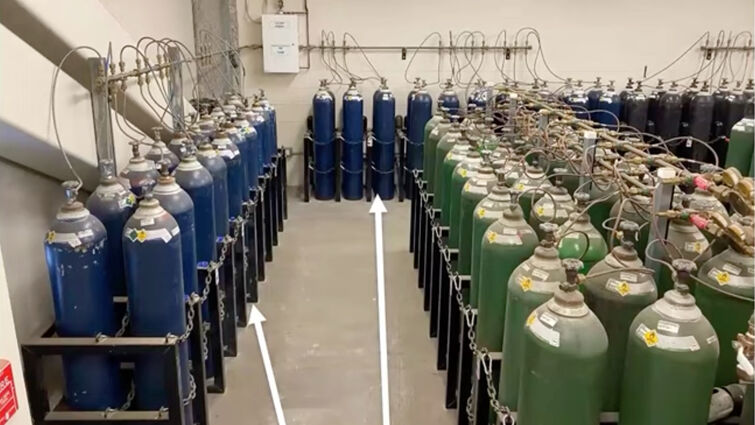
LLUH began a systemwide transition away from piped nitrous oxide, relying instead on portable e-cylinders
At Loma Linda University Health, caring for our patients also means caring for the environment that shapes their health. This commitment has driven a major clinical transformation over the past year: decommissioning of piped nitrous oxide systems across LLUH hospitals and the removal of desflurane from the pharmacy formulary. Together, these steps dramatically reduce the environmental impact of anesthetic gases—some of the most potent greenhouse gases used in healthcare.
Anesthetic gases are essential in surgery, but their climate effects are profound. Nitrous oxide (N₂O) has nearly 300 times the global warming potential of carbon dioxide and remains in the atmosphere for more than a century. Desflurane, another inhaled anesthetic, also carries a very high global warming potential—one hour of use has a carbon footprint comparable to driving 200–400 miles. Studies across the healthcare sector show that anesthetic gases typically account for more than half of an operating room’s emissions, making them a high-impact target for environmental stewardship.
Historically, LLUH operating rooms operated with a built-in redundancy: nitrous oxide was supplied through building-wide piping fed by large H-cylinder arrays, while anesthesia machines also carried portable e-cylinders. The piped system remained continuously pressurized, which led to ongoing nitrous oxide waste throughout the distribution network. An internal review showed that 80% of purchased nitrous oxide was never delivered to patients, highlighting a significant opportunity to reduce waste.
To address this, LLUH began a systemwide transition away from piped nitrous oxide, relying instead on the portable e-cylinders already mounted on anesthesia machines. Because e-cylinders release gas only when opened by the clinician, they significantly reduce waste—by up to 80%. A pilot phase began in March 2025, when hoses supplying nitrous oxide to the ORs were disconnected. After no issues were reported, full decommissioning was completed at Loma Linda University Medical Center, Children’s Hospital, East Campus, Surgical Hospital, and the Faculty Medical Clinics. The next phase will explore whether similar changes are feasible at LLUMC-Murrieta and the School of Dentistry. Health systems across the country are making similar changes as the industry works to adopt more sustainable and responsible approaches to anesthetic gas management.
“This new approach allows us to continue delivering high-quality anesthesia while greatly reducing unnecessary gas waste and its impact on the environment,” said Ryan Lauer, MD, medical director of the Operating Room, who served as the project’s clinical lead. “Anesthesia teams will still be able to control how deeply anesthetized patients are during surgery, and how comfortable they are after the procedure. This change brought attention to a form of waste that had gone largely unnoticed—and now we’ve been able to eliminate it.”
The success of this effort reflects extensive teamwork across the organization. The project has been a collaboration among Anesthesia, OR Nursing, Supply Chain, Facilities, Campus Engineering, Finance, Community Benefit, AirGas, Biomed, medical students, and the Environmental Sustainability Committee, with critical leadership support from Sharon Lum, MD, chair of Surgery, who has helped educate teams about anesthetic gas impacts and sustainable clinical practices. This broad coalition ensured that operational needs, clinical requirements, safety considerations, regulatory requirements, and sustainability goals were aligned from the start.
Earlier this year, LLUH ended the use of desflurane, one of the most environmentally harmful anesthetic gases—2,450 times more damaging than carbon dioxide and offering no clinical advantages. Removing desflurane from the pharmacy formulary eliminating one of the highest-impact anesthetic agents from use. Clinicians continue to have access to safe, effective alternatives such as sevoflurane, ensuring that patient care remains seamless.
These changes reflect a growing interest among LLUH clinicians to integrate sustainability into everyday practice. By rethinking how anesthetic gases are managed across our system, we are reducing greenhouse gas emissions, improving operational efficiency, and strengthening our commitment to environmental stewardship. It is one more way our organization is advancing healing beyond the bedside—caring not only for individual patients, but also for the communities and environment we all share.